Currently on Display — Broadsides: Fusing Word and Design

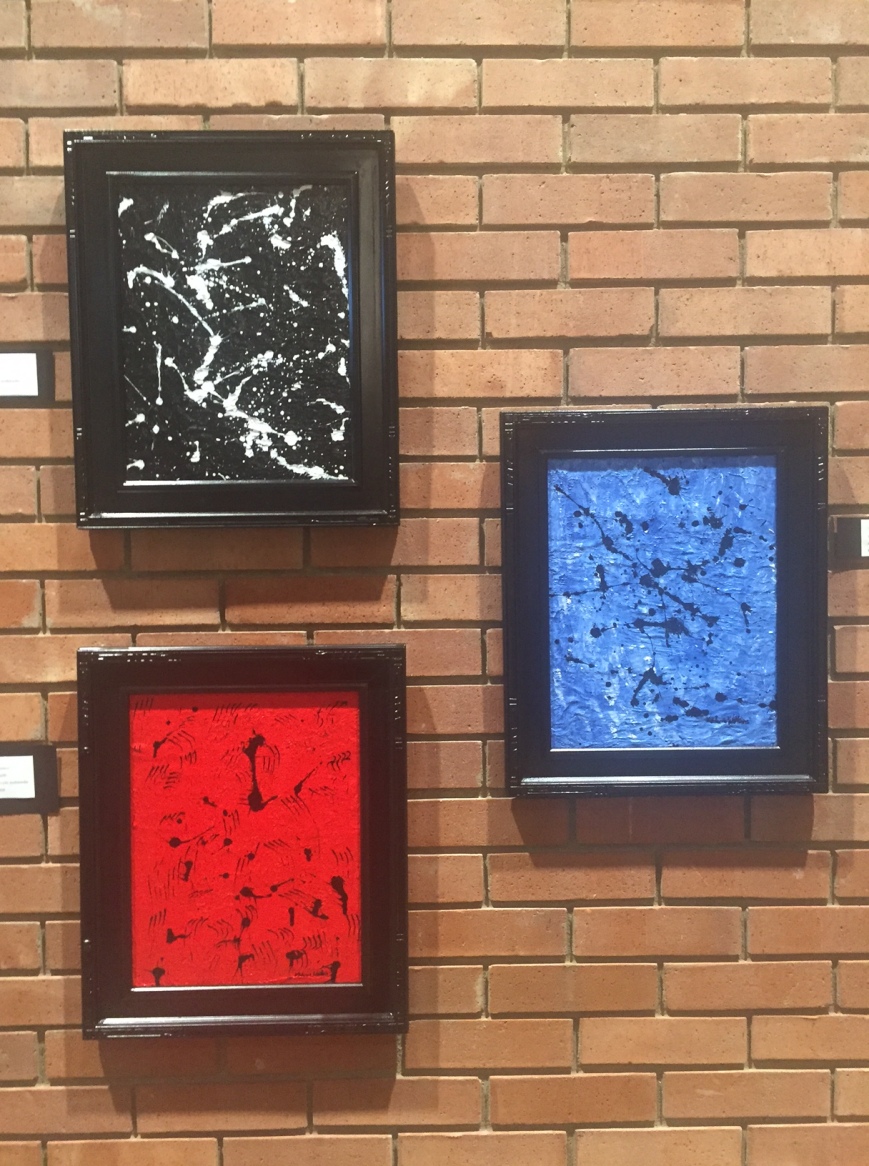
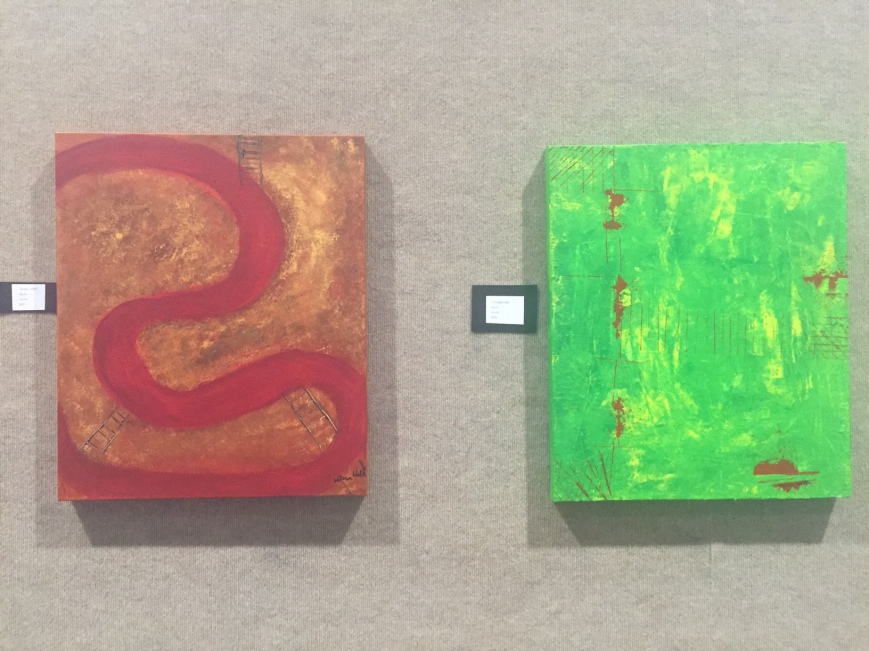
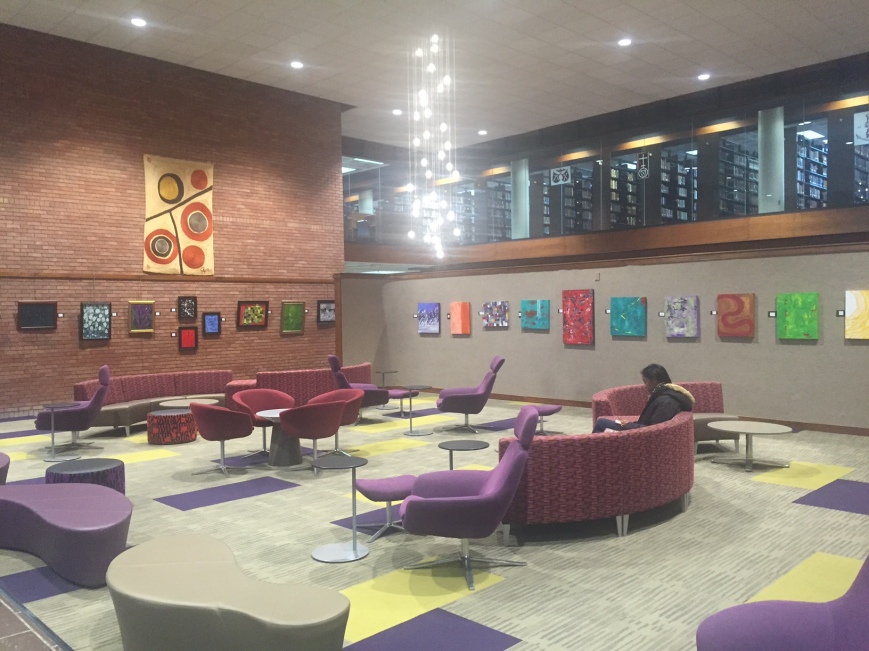
April is National Poetry Month and to celebrate, students from the fall 2012 Advanced Creative Writing and Advanced Graphics Design classes, taught by Dr. Libby Jones and Dr. Alan Mills, respectively, collaborated to create stunning broadsides currently on display on the main floor of Hutchins, behind the Inauguration Exhibit.

broadside

 Sometimes called broadsheets or broadside ballads, broadsides were originally one-sided advertising circulars or ballads or popular songs printed on one side of a sheet of paper and sold by hawkers, especially in 16th-century England.  Broadsides were what people used to get their words out in a fashionable, attention-demanding way before modern magazines, newsprint, and billboards existed.

The broadsides currently on display are the work of the 21 students from the two classes who worked together in small groups to select writings, prepare design possibilities, and meld ideas to create works that reflect influence from both branches of artistic thought. 

For more information about the pieces on display or the process that went in to creating them, contact:

Libby Falk Jones, Ph.D.
Chester D. Tripp Chair in Humanities
Professor of English
Berea College, Berea KY 40404
859-985-3757

Coming to Campus: Entangled Lives

The presentation Entangled Lives: A Conversation Between Descendants of “Master” and Enslaved will be visiting campus next week. Co-sponsored by the Carter G. Woodson Center for Interracial Education and the African American Genealogy Group of Kentucky, the presentation is an ever-evolving project of public history created by Pam Smith and Ann Neel.

entangled lives

Pam Smith and Ann Neel met and became friends over 20 years ago through a mutual passion for family history research. Ann, a white Professor Emerita of Sociology and Women Studies and Pam, a black communications consultant and current Graduate Student in History, created this presentation when they discovered that one of Ann’s ancestors had owned one of Pam’s in slaveholding Missouri. Their particular family stories are deeply embedded in the massive entangled migration of white and black families across the North American continent, from the Atlantic to the Pacific, within a social structure that enforced black subordination with ideologies of white supremacy. This presentation is designed to show how racial reconciliation and genuine friendship in the present becomes possible when honest communication and about the harms and pain of the past is accompanied by large doses of care, tenacity, courage, and humor.

This program will be presented on Friday, April 19th from 11:30 – 1:00 and again on
Saturday, April 20th at 1:00 p.m at the Carter G. Woodson Gallery.

For more information, contact Hutchins Library’s own Sharyn Mitchell via email at: sharyn_mitchell@berea.edu

Reference Book of the Week: Women in Combat

March is Women’s History Month, so we are featuring a reference book about women in our semi-regular feature Reference Book of the Week. Women in Combat: A Reference Handbook is part of the Contemporary World Issues series published by ABC-CLIO. This series covers topics such as animal rights, lobbying in the U.S., environmental justice, and women in combat, which is our highlight this month. This series provides a good starting point for research in the topics the series covers. You can start your research with a book like Women in Combat and then move on to more in-depth tools such as article databases.

Women in Combat features eight chapters filled with good information. Some of the chapter topics include:

  • Background information and history of women in war and combat.
  • Problems, controversies, and solutions related to women in combat roles. Issues such as women’s physical abilities, effect on readiness, and societal expectations are discussed here.
  • A selection of primary documents and statistics.
  • A chapter on print and nonprint sources featuring books, journals, hearings, and Internet sites, and more.

This is an easy to use and read reference book. It is well organized, and it features a good index to help you find any specific terms or information of interest. The role of women in combat is a topic that comes and goes in the news cycle as women continue to fight for equality in and out of the battlefield. This book is a good resource to get a better understanding of this topic, plus it provides good guidance for further research and exploration.

You can find the book in the library’s reference collection. The call number is R 355.408 S626w 2011.

“Learning New Old Songs” – An Appalachian Sound Archives Fellowship Presentation

Wednesday, March 20 at 3:00
Hutchins Library Room 106
“Learning New Old Songs”
Appalachian Sound Archives Fellowship Presentation

sara

Saro Lynch-Thomason will discuss her study of Kentucky ballads in Berea’s Appalachian music collections, specifically those which have mostly fallen out of oral tradition. She is building a singing repertoire of 25-30 pieces with the object of revitalizing these rare stories and melodies in Southern Appalachian singing communities.

Saro has already begun sharing her learning in informal singings on campus. Over the next several months she will be conducting a series teaching workshops in West Virginia, Kentucky, Tennessee and North Carolina; establishing an on-line teaching resource; and developing a show featuring songs from this repertoire, including stories and memories from the source singers.

Saro sings at regional festivals, teaches in ballad-singing workshops, and leads a weekly community singing group that trades and teaches songs. Her previous traditional music research and production work includes Blair Pathways, a musical exploration of the West Virginia Coal Wars (1902-1921) via a 20-track CD and multi-page historic narrative.

  Light refreshments will be served.

The Berea College Appalachian Sound Archives Fellowship Program
brings scholars, performers, composers, and educators to Berea to study in Hutchins Library’s
Special Collections & Archives’ rich collection of non-commercial sound recordings
.

Our Alumni are the Coolest: Carter G. Woodson, the “Father of Black History”

This is the second entry in what I hope will be a semi-regular feature dedicated to our amazing alumni. Today I will pay homage to Carter G. Woodson, the historian and Berea alum responsible for the creation of Negro History Week, which later became the annual celebration we call Black History Month. As Black History Month 2013 winds down, I believe we would be remiss if we failed to honor Dr. Woodson, who first demanded that the legacies of the many African Americans who came before us be acknowledged and celebrated. Speaking to the need to preserve black history, Woodson said “If a race has no history, if it has no worthwhile tradition, it becomes a negligible factor in the thought of the world, and it stands in danger of being exterminated” (Goggin).

Woodson_Carter_G

Carter G. Woodson was one of nine children born to former slaves on a farm in Virginia. During his teens, his family moved to West Virginia and Woodson began working in the coal mines. Determined to secure an education for himself, Woodson enrolled in high school at the age of twenty and completed four years of studies in just two years. After graduation, he attended Berea College and then Lincoln University, ultimately returning to Berea to graduate in 1903, just one year before the Day Law made interracial education illegal in the state of Kentucky.

After graduating from Berea, Woodson went on to study at the Sorbonne in Paris and at the University of Chicago, where he earned a master’s degree in European history. In 1912, he earned a Ph.D. in history from Harvard; he was only the second African American to have earned a Ph.D. from Harvard at the time (the first was W.E.B. Du Bois). Even more remarkable still, he was and is the first and only black American of slave parents to ever earn a Ph.D. in history.

In 1915, Dr. Woodson founded the Association for the Study of Negro Life and History, the first historical society dedicated exclusively to research on African Americans. In that same year, he also published his first book, The Education of the Negro Prior to 1861. Soon after, he founded two academic journals – the Journal of Negro History and the Negro History Bulletin – as well as a publishing house, the Associated Publishers. He spent the remainder of his life publishing in the field of African American history, ultimately producing four monographs, five textbooks, thirteen articles, and multiple sociological studies and edited collections.

In addition to writing prolifically, Dr. Woodson taught at the high school and college levels before serving administratively as a Dean at Howard University and West Virginia State College. While all of the accomplishments make him a man worthy of praise, the reason I thought of him today was because of the debt all history lovers owe him for his founding of Negro History Week (now Black History Month) back in 1926. As W.E.B. Du Bois said about this contribution, Woodson “literally made this country, which has only the slightest respect for people of color, recognize and celebrate each year, a week in which it studied the effect which the American Negro has upon life, thought, and action in the United States. I know of no one man who in a lifetime has, unaided, built up such a national celebration” (“Carter G. Woodson”).

Sources

“Carter G. Woodson.” Contemporary Black Biography. Vol. 2. Detroit: Gale, 1992. Biography In Context. Web. 18 Feb. 2013.

“Carter Godwin Woodson.” American Decades. Ed. Judith S. Baughman, et al. Detroit: Gale, 1998. Biography In Context. Web. 18 Feb. 2013.

Goggin, Jacqueline. “Carter G. Woodson.” Encyclopedia of African-American Culture and History. Gale, 2006. Biography In Context. Web. 18 Feb. 2013.

Reference Book of the Week: African American Religious Cultures

We continue celebrating Black History Month in our semi-regular series of Reference Book of the Week. This week we look at African Americans and religion in the two-volume set African American Religious Cultures (R 200.899 A2575 2009). This set, edited by Anthony B. Pinn, takes a look not only at the United States, but the American continents. The introduction states that this work is “concerned with the religious worlds of African Americans– the wide-ranging and complex communities of people of African descent who populate the hemisphere” (xxx). Whether you want to learn about the experience of African Americans in organized religions or their experiences in other spiritual paths, this is a good resource for you.

The set is organized as follows:

  • An introduction that provides a good context on African American religious cultures. The introduction discusses how African Americans came to the New World, the experience of slavery, and how their religious traditions have evolved over time in the Americas. The introduction does feature a very good bibliography for further reading.
  • A set of entries in alphabetical order. Topics such African Americans in various mainstream churches (Lutheran, Roman Catholic, etc.) as well as other religious traditions are discussed. The entries run from A (African American mysticism) to R (Rastafari) in the first volume and from S (Santeria) to X (Xango) in the second volume. According to the introduction, this first part of the encyclopedia is “concerned with a sense of religion by means of attention to particular traditions. . . ” (xxxi). Each entry has a bibliography so readers can expand their research on these topics.
  • The second volume also includes a set of essays on larger topics, a chronology of events, and an appendix containing a selection of primary documents. Do note that the essays focus mainly on North America because “it is assumed most users of this encyclopedia are situated in North America, particularly in the United States” (xxxi). However, the essays should be valuable to any reader anywhere in the world.

Overall, this is a basic encyclopedia designed to give readers some solid background information on the religious cultures of African Americans. After using this resource, readers should be able to to do more in-depth reading. One way to do that is by using the bibliographies provided throughout the encyclopedia and locate items cited. For books cited in the encyclopedia, readers here in Berea College can use BANC (our library catalog) to look up any book. For articles cited in the encyclopedia, you can search our Full Text Journals tool to see if we own a particular journal containing the article. If you are a reader at a different college or community, your local library probably has a library catalog and a tool similar to our Full Text Journals tool to help expand your search. At any rate, any time you need assistance, near or far, you can contact our reference desk.

African American Religious Cultures is available in the second floor of Hutchins Library, in the reference section. Just use the call number provided above to find it.